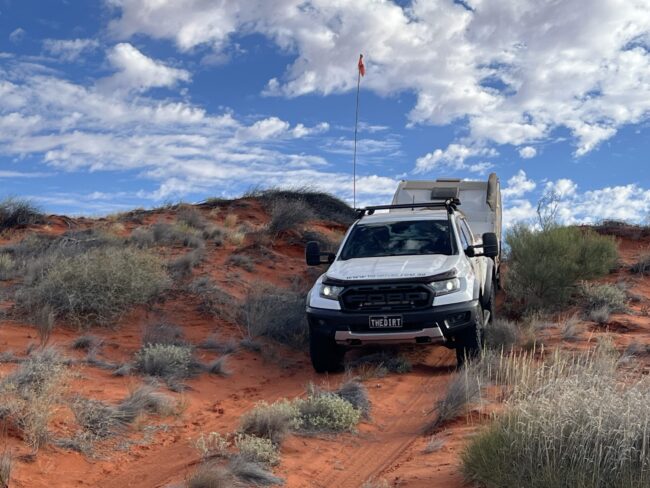
Choosing the right camper for the Canning Stock Route (CSR) isn’t about features on paper — it’s about what still works when you’re thousands of kilometres from help.
As an off-road camper dealer, we’re fortunate — and sometimes cursed — with choice.
Over the years, we’ve been fortunate enough to tour some of Australia’s most remote and unforgiving tracks, including the Anne Beadell Highway, Sandy Blight Junction, and the Madigan Line. We’ve also spent 13 months travelling Australia on a Big Lap — the kind of trip that lets you go well beyond the postcard stops and properly immerse yourself in the remote places that four weeks of annual leave simply can’t reach.
So when it came time to choose a camper for the Canning Stock Route, we didn’t take the decision lightly.
After looking hard at what’s on the market, we purchased a Track Trailer Mk6 Tvan Murranji — and now, having taken delivery, we’re in the process of setting it up for the trip.
What we were looking for in a camper
When choosing a camper for the CSR, reputation only gets you so far.
What matters is how a camper is likely to perform after thousands of kilometres of corrugations, countless camp setups, and weeks of living out of it in remote country.
That’s the lens we used to assess the Mk6 Tvan.
We start with one question: “What fails first?”
Remote desert travel has a way of stripping things back to fundamentals. Comfort matters — but reliability, simplicity, and repairability matter more.
When we evaluate any camper for serious remote touring, we’re looking closely at:
- Structural integrity over corrugations
- Suspension design and serviceability
- Dust and water management
- Weight, balance, and how the camper behaves behind the vehicle
- How liveable it is after ten, twenty, thirty consecutive days
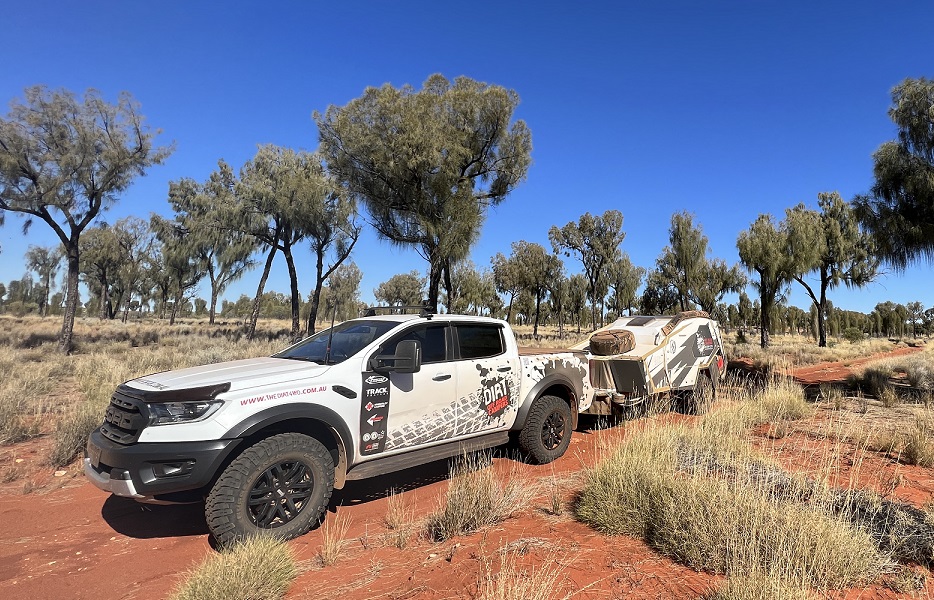
The Mk6 Tvan scores highly across all of these, not because it’s flashy, but because it’s purpose-built.
The Tvan layout still makes sense — especially long term
The Tvan’s layout has always been polarising. Some people love it immediately; others need time to understand it.
After extended desert travel, we’re firmly in the first camp.
One of the Tvan’s biggest strengths is its versatility. Depending on the conditions and how long we’re staying, we can choose from three distinct setup modes.
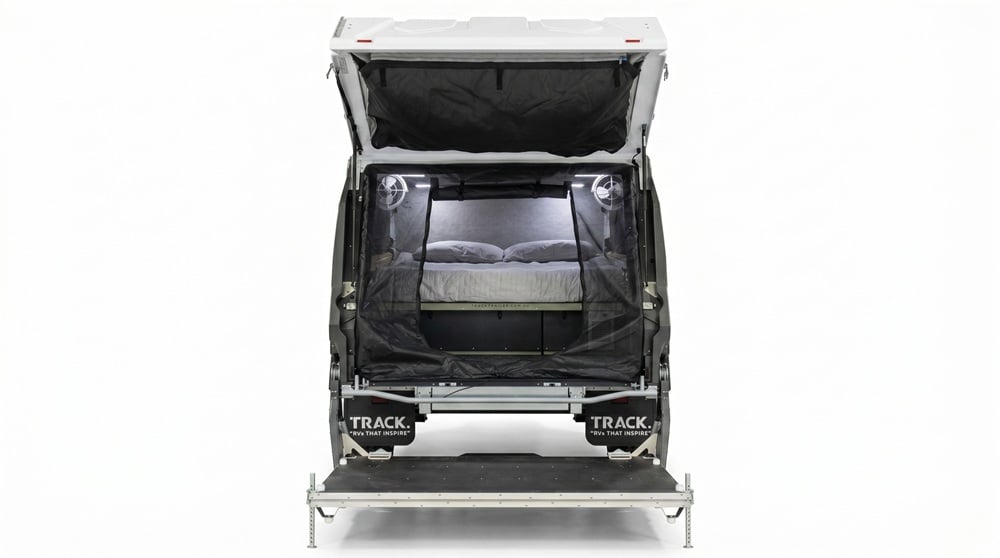
For a quick overnight stop, simply fitting the rear insect/canvas screen provides a comfortable sleeping area with minimal setup. If the weather turns wet, cold or windy, the rear hatch can be pulled down and the Tvan used much like a teardrop camper, allowing access to the bed while remaining protected from the elements.
Most of the time, however, we’ll deploy the rear tent. In around four minutes, the Tvan transforms into a spacious touring camper with standing room to get changed, private access to our Cuddy composting toilet, and a useful covered utility space. On longer trips, particularly when the weather is less than ideal, that additional living space makes a significant difference to comfort and enjoyment.
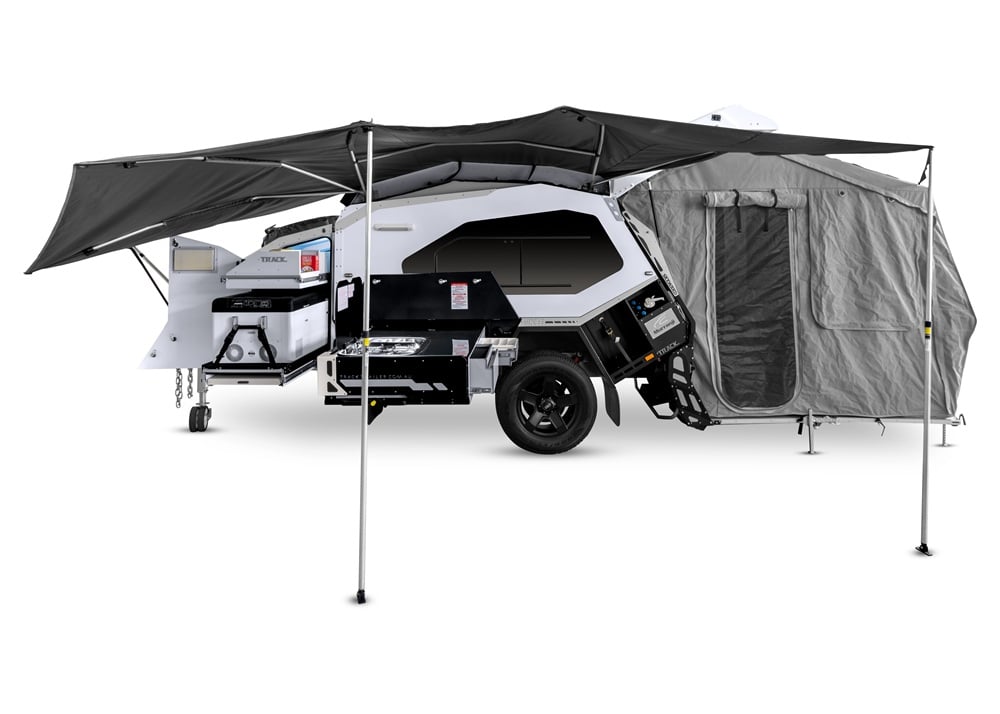
That expanding living area is one of the reasons the Tvan continues to appeal to us. While many compact campers and micro-hybrids prioritise a small footprint and rapid setup, the Tvan’s hard-floor rear tent creates a genuine sense of space that is difficult to replicate in a compact body. When you’re spending weeks on the road, particularly during poor weather or rest days in camp, that extra room can make a surprising difference to comfort and overall enjoyment of the trip.
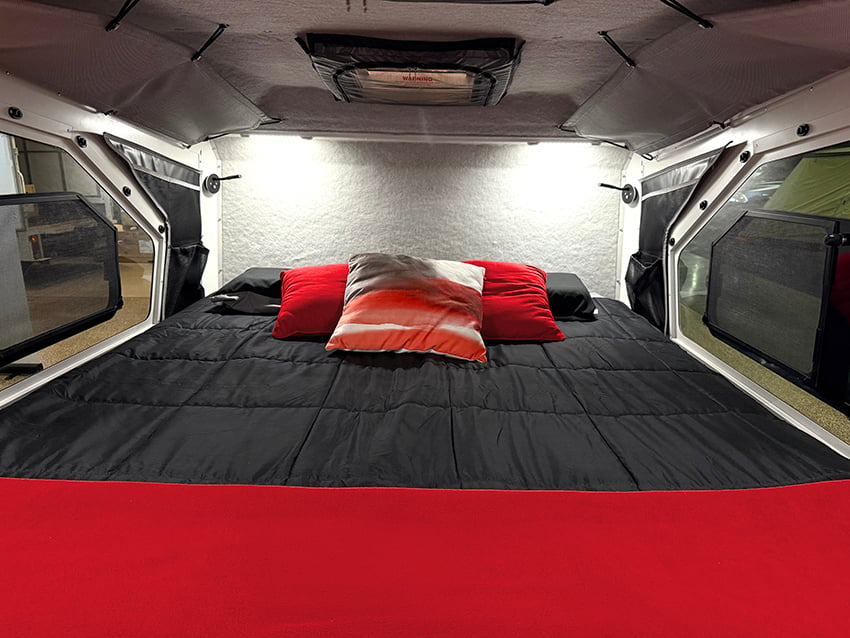
For us, four minutes of setup is a small price to pay for the additional space, privacy and comfort it provides.
The cocooned sleeping area and expanding hard-floor tent make practical sense when:
- The weather turns cold, wet or windy
- You’re setting up and packing down regularly
- You want minimal canvas exposure
- Comfort and dust management become important on longer trips
- You need to keep weight low and centred
The insulated sleeping pod remains comfortable and protected regardless of conditions, while the rear tent provides additional living space when and where it’s needed. Just as importantly, the bed remains isolated from the canvas, meaning damp or wet canvas doesn’t end up folded onto your bedding when it’s time to pack up and move on.
The Tvan layout prioritises practicality, versatility and low setup effort — particularly valuable when travelling for extended periods and changing camps frequently.
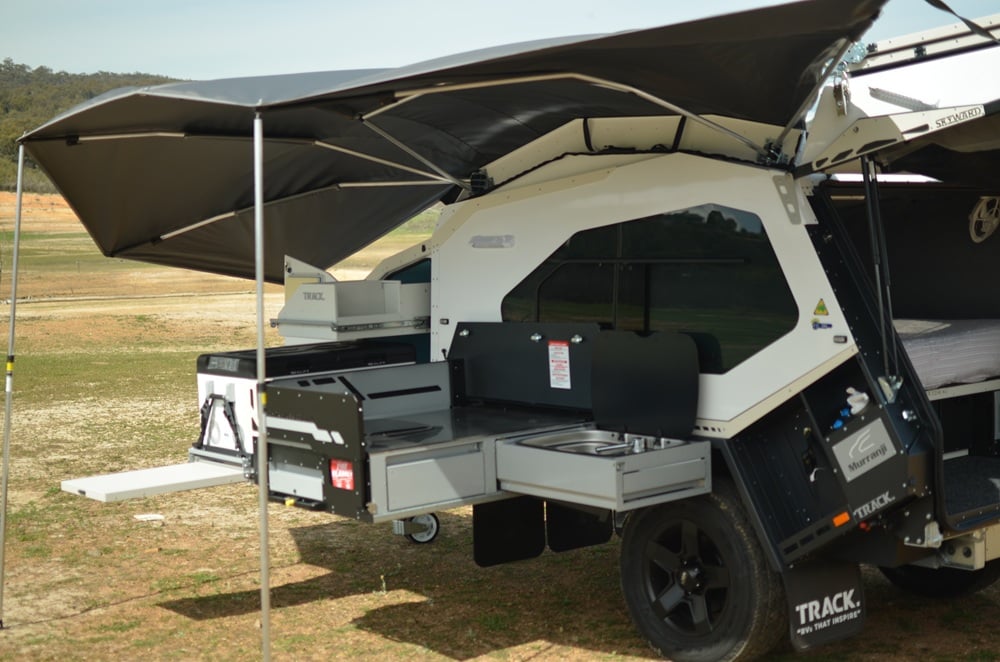
The current premium kitchen — a significant evolution from Track’s earlier slide-out design — offers more usable food preparation space, a larger stove, easier-access drawers, a pull-up windshield, and hot water to the sink. These might sound like small things, but over weeks on the road they make day-to-day living noticeably easier.
The Mk6 refines this without losing what made the Tvan work in the first place. It’s not trying to be a hybrid caravan or a luxury apartment on wheels. Instead, it remains a purpose-built touring camper designed to go further, stay lighter, and make life easier in remote places.
Suspension & Chassis: proven where it counts
We’ve towed Tvans on some very ordinary tracks, and the suspension design has always been one of its strongest points.
The Mk6 continues with:
- Long-travel independent suspension
- Excellent ground clearance
- A compact footprint that tracks well behind the tow vehicle

On narrow desert tracks, dune crossings, and deeply corrugated sections, stability and predictability matter far more than headline specs. The Tvan’s ability to follow the vehicle without drama is a big reason we’re confident taking it onto the CSR.
Why the Mk6 (specifically) was the right time
We didn’t rush into this decision. The Mk6 tipped the balance because it addressed a number of small but important refinements:
- Greater interior space and usable headroom, making day-to-day living noticeably more comfortable
- Larger, better shaped awning for improved weather protection
- More considered storage solutions
- Subtle usability improvements that matter over long trips
- A feeling that lessons from decades of real-world use have been carried forward
These aren’t changes that jump out in a brochure — but they matter when you’re thousands of kilometres into a trip like the CSR.
Why we chose to back the Mk6 ourselves
We’re upfront about the fact that we’re a Track Trailer dealer, and that our Mk6 Tvan has been purchased through our business.
That’s not something we shy away from — if anything, it raises the stakes.
Choosing the Mk6 Tvan as the platform for our Canning Stock Route trip meant committing our own capital, our own time, and our own reputation to the same product we recommend to customers. We had the option to simply sell the Mk6 and talk about its capability. Instead, we chose to rely on it in one of Australia’s most remote environments.
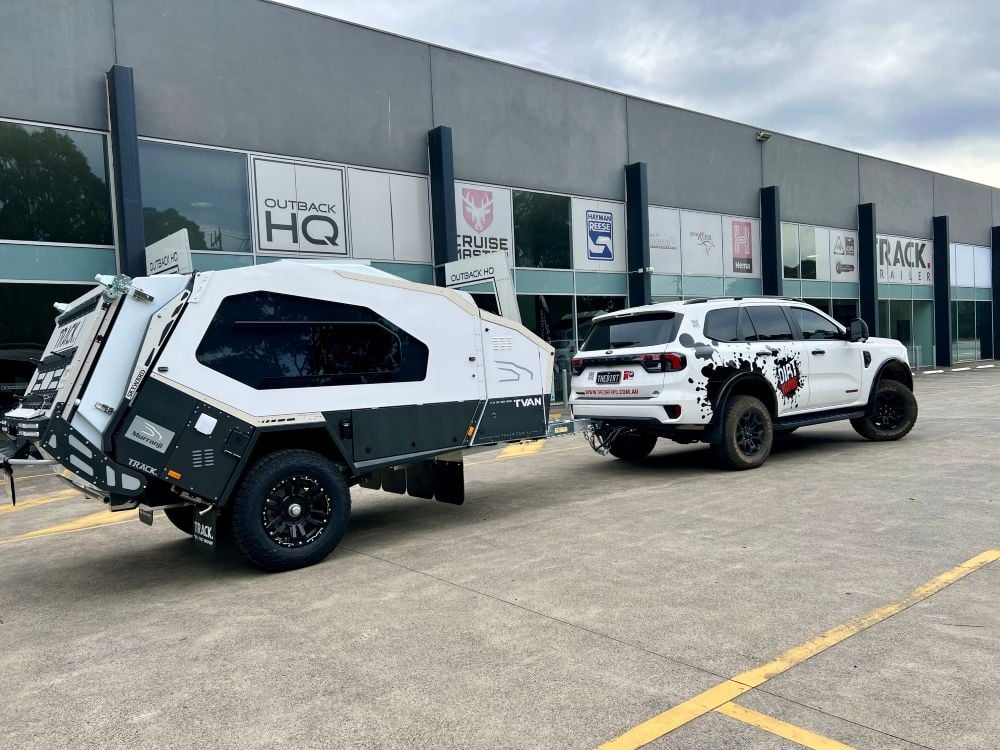
We’ve now taken delivery of our Mk6 Tvan Murranji and have begun preparing it for remote touring and the Canning Stock Route.
Importantly, this isn’t our first Tvan. We purchased our first new Tvan in 2006, before we even started The Dirt Off Road Campers. Since then, we’ve owned and travelled extensively in Mk2, Mk3 and Mk5 Tvans, using them to explore some of Australia’s most remote regions.
That history is one of the reasons we approached the Mk6 with a healthy mix of excitement and scrutiny. We already knew the strengths of the Tvan platform. The question wasn’t whether the concept worked — we’d convinced ourselves of that years ago. The question was whether the Mk6 genuinely improved on a camper we already knew and trusted.
Having now taken delivery, we’re beginning to appreciate the refinements. The core philosophy remains unchanged, but there are numerous improvements in comfort, usability and day-to-day practicality that become more apparent the more time you spend with it.
We’re still early in that process, which is exactly where we want to be — learning, refining and preparing before the Mk6 is properly tested in the remote conditions it was built for.
Who the Mk6 Tvan is (and isn’t) for
The Mk6 Tvan isn’t trying to be everything to everyone.
It’s for people who:
- Prioritise capability over internal volume
- Value durability over glitz
- Plan to travel remote, not just talk about it
- Understand that good design is often driven by practicality rather than appearance.
That philosophy extends to the setup itself. The Tvan does require a degree of mobility to deploy the rear tent, but the process on later-model Tvans is significantly easier than earlier generations and most owners quickly develop a routine that takes only a few minutes.
Part of the appeal for us is the simplicity. Rather than relying on motors, actuators, sensors and electronic deployment systems, the Tvan uses a straightforward mechanical setup that is easy to understand and inherently suited to remote travel. That’s one less system to worry about when you’re hundreds of kilometres from the nearest workshop.
For us, a few minutes of setup is a worthwhile trade-off for a comfortable insulated sleeping area, generous living space and the confidence that comes from a simple, proven design.
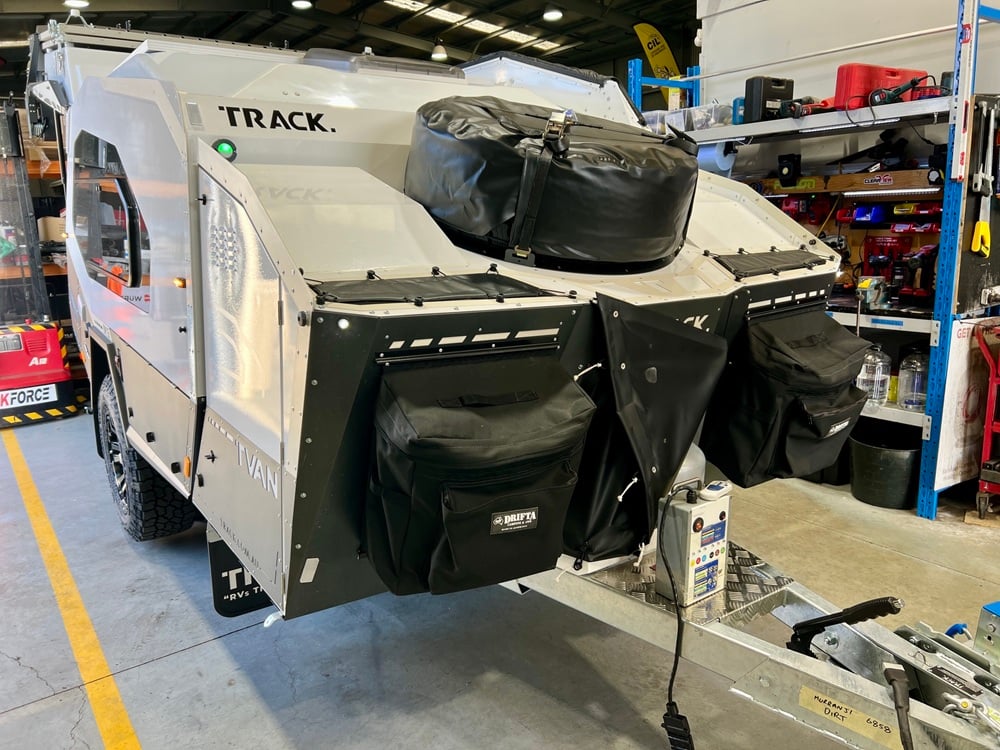
If that sounds like your style of touring — particularly if remote trips like the Canning Stock Route are on the list — the Mk6 deserves serious consideration.
What comes next
This article explains why we chose the Mk6 Tvan for the Canning Stock Route. In the lead-up to the trip, we’ll be documenting the preparation process in detail, including:
How we’re setting up our Mk6 in real terms
Why we’ve chosen certain options (and skipped others)
How we’re preparing our Everest Tremor for remote desert travel
Recovery planning, communications and safety equipment
Our Border Track shakedown trip
What we’re learning now that we’re living with the Mk6
Honest reflections once it’s been tested in remote conditions
We’re not interested in hype — only in sharing what holds up when it actually matters.
If you’re in South Australia or the Northern Territory and are researching the Mk6 Tvan, feel free to reach out. Whether you’re planning a Big Lap, remote desert travel or simply exploring your options, we’re always happy to have a chat and share what we’ve learned from our own travels.
Previous Desert Adventures – click on the links below
Thinking About a Tvan?
Follow Our CSR Preparation
- How We’re Preparing Our Mk6 Tvan for the CSR
- Border Track Shakedown
- Everest Setup (coming soon)